
Tyre emissions in focus as researchers gather in Berlin
%20Ida%20och%20Benjamin%20i%20Berlin.webp)
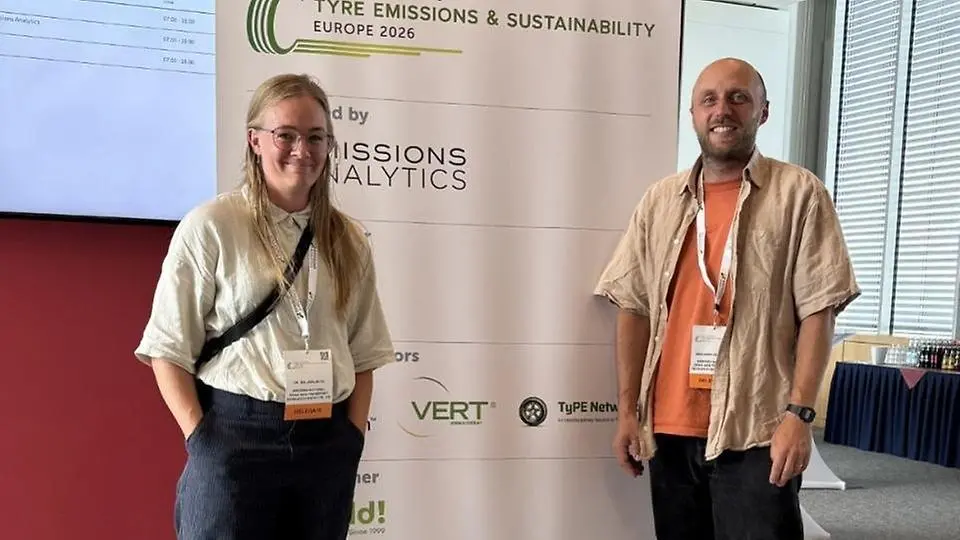
Ida Järlskog and Benjamin Holmberg. Foto: VTI
Researchers from VTI recently took part in the Tyre Emissions and Sustainability Europe Conference in Berlin, where scientists, tyre manufacturers, policymakers and testing organisations met to discuss the latest research on tyre wear emissions, sustainability and future regulations.
Supporting the LIFE-NEEVE project
Between 7 and 8 July, VTI researchers Ida Järlskog and Benjamin Holmberg attended the Tyre Emissions and Sustainability Europe Conference hosted by Emissions Analytics in Berlin. The event focused on the latest developments in tyre wear emissions, sustainability and future regulations.
As part of the LIFE-NEEVE project, VTI is responsible for identifying and selecting low-emission tyres for an upcoming pilot study using convoy testing according to the UNECE Task Force Tyre Abrasion (TFTA) methodology. The conference therefore provided an excellent opportunity to present and discuss the preliminary test setup and results, while exchanging experiences with leading experts working on tyre wear measurements and non-exhaust emissions.
Research and new developments
Several presentations were directly relevant to the work for LIFE-NEEVE. Topics included the implementation of the upcoming Euro 7 tyre abrasion regulation, improvements to standardised abrasion testing, measurement of airborne tyre wear particles, and the relationship between tyre mass loss and particle emissions. Researchers also presented new methods for real-time monitoring of particle size distributions and studies on how tyre composition, temperature and driving conditions influence wear emissions. Beyond measurement techniques, the conference highlighted ongoing developments in sustainable tyre materials, circular use of raw materials and the environmental impacts of tyre additives, reflecting the growing importance of reducing non-exhaust emissions while maintaining tyre performance and safety.
Knowledge exchange and collaboration
The conference provided valuable insights into the rapidly evolving research field of tyre emissions and strengthened VTI's network with researchers, industry representatives and regulatory experts. The discussions and knowledge gained will support the continued work within LIFE-NEEVE towards identifying tyres with lower environmental impact and contributing to future methods for reducing non-exhaust emissions from road traffic.
What are non-exhaust emissions?
Non-exhaust emissions are particles released from road traffic that do not come from the exhaust pipe. They include fine particles (PM2.5 and PM10) and microplastics generated by tyre wear, brake wear, road surface wear, and road dust resuspension.
The LIFE NEEVE project studies how both tyre and brake systems contribute to these emissions under real driving conditions, and how material properties and friction influence particle formation.
As exhaust emissions decrease, non-exhaust sources are becoming a growing share of total traffic-related pollution, with increasing focus on tyres, brakes, and road surfaces.