
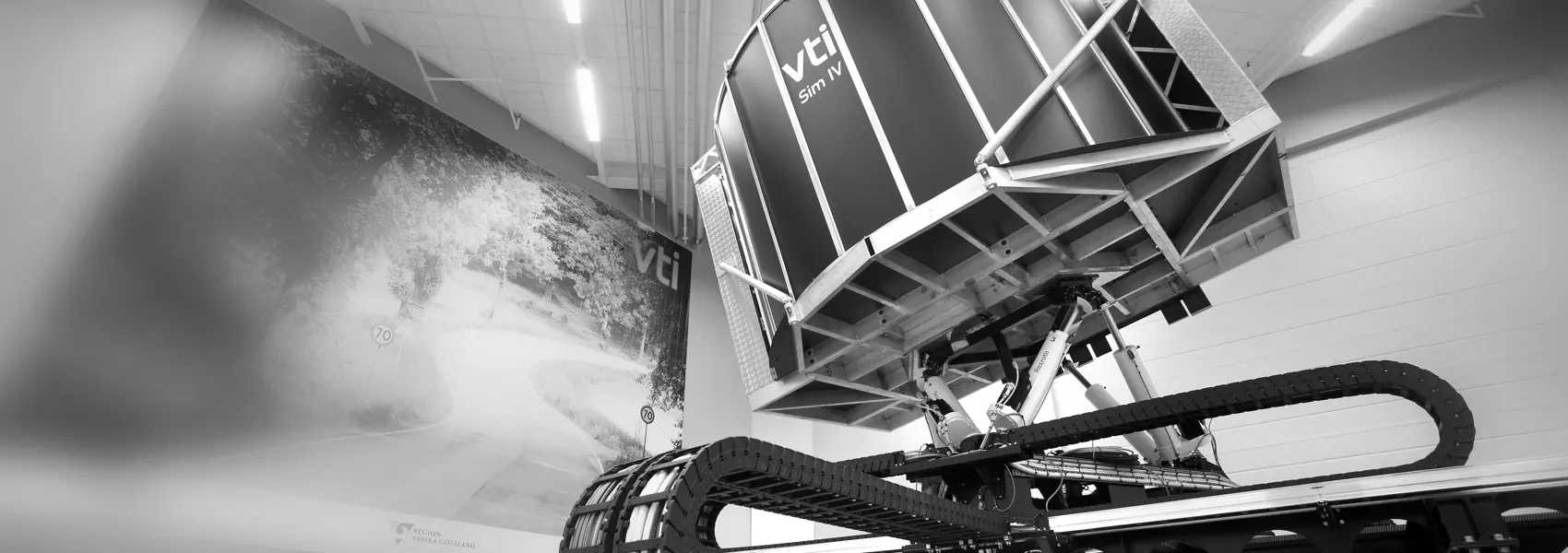
How time delays in driving simulators affect driver behaviour
About the thesis project
In general, it is observable that time delays give differences in behavior, but it is unclear which delays cause which effects. Delays of different magnitudes and in different parts of the simulator are also expected to affect behaviour differently. For example, a delay in the visual system might not be noticeable, while a similar delay in the moving-base system could be clearly noticeable. Delays that drivers do not notice may still affect their behaviour.
Further, delays also affect the simulator timeliness resulting in events that should occur at the same time might have different offsets in different parts of the simulator.
If delay sizes are known in different parts, can the software compensate so that timeliness is maintained better?
The main topic is to investigate the effects on driver behavior from time delays in different parts of the simulator system.
Important parts are visual system, moving base system, vehicle model and steering characteristics/feedback.
If delay sizes are known in different parts, can the software compensate so that timeliness is maintained better?
The thesis work includes the following tasks:
- Literature and state of the art study
- Measure latencies in different parts of the simulators
- Software development to enable run-time time delays in different simulator systems
- Run a driving simulator study with different delays
- Collect results in a report
The thesis is available for one or two students. For communication it is mandatory with English and Swedish is meritorious.
- Educational background in the areas of vehicle engineering, computer engineering or a similar area
- Experience of programming and simulation
- Ability to work independently and to take initiatives
Practical information
The thesis is available for one or two students and will be carried out at the Vehicle systems and Driving simulators unit at VTI, either at the Linköping or Gothenburg office.
Questions and application
For questions and application contact
Anders Andersson - anders.andersson@vti.se
Research on future vehicles and transport systems
At VTI's Vehicle Systems and Driving Simulation (FSK) unit, we study how future vehicles and transport systems can be developed, tested and evaluated.
We combine advanced simulation, experimental testing and systems analysis to investigate complex questions in safe and realistic environments.
This is where technology, people and transport systems come together – and as a Master's thesis student, you will have the opportunity to work closely with current research.