
How driving simulator dynamics affect simulator sickness
About the thesis project
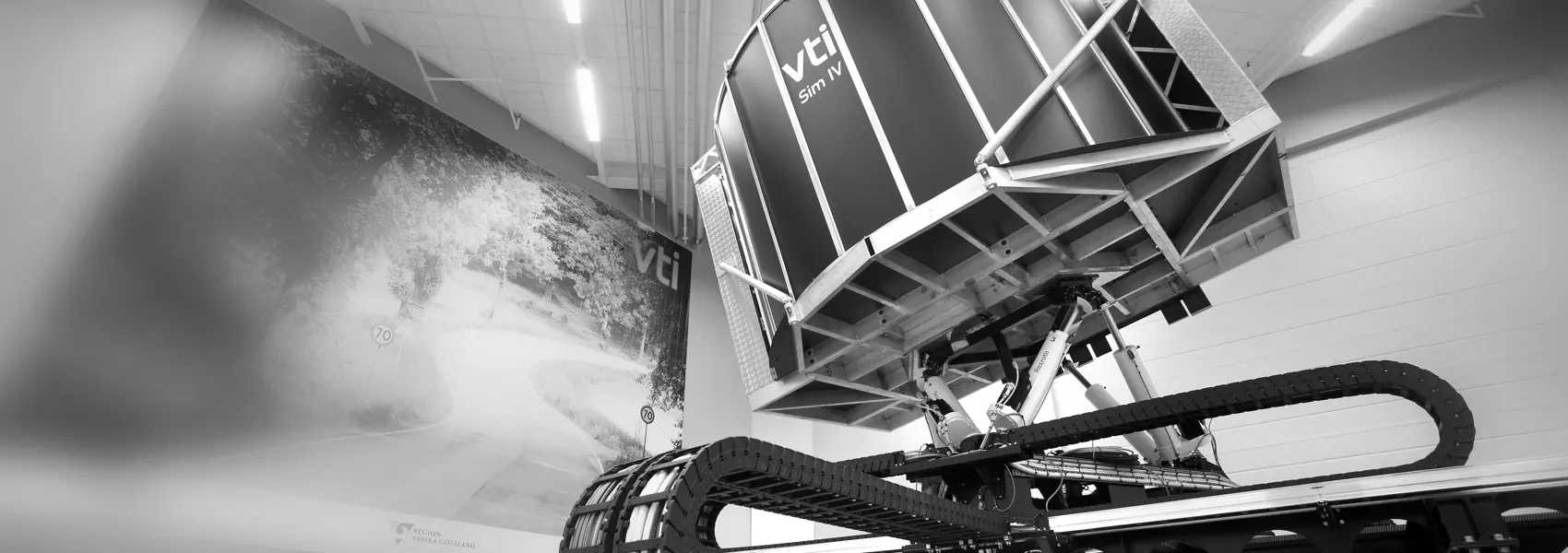
In general, studies in advanced moving-base simulators can provide more accurate representations of driver behaviour than studies in static driving simulators. One reason is that the moving platform provides feedback on vehicle dynamics. However, limitations in simulator space and actuator performance mean that the full range of vehicle dynamics cannot be replicated. During highly dynamic driving, this can increase simulator sickness.
VTI's Vehicle Systems and Driving Simulation unit manages a large collection of simulators, including two large moving-base driving simulators, smaller static driving simulators, and simulators for trains and vulnerable road users such as pedestrians and cyclists.
The simulators can use screens, projectors or XR technology and can be connected for multi-actor simulations, for example to study interactions between drivers and pedestrians. This provides many options for designing a study.
How does the choice of simulator setup and dynamics platform control affect simulator sickness?
The aim is to estimate simulator sickness in static or dynamic driving simulators based on the driving task used in the study, and to provide guidance on how a selected setup could be modified to improve the study.
Two approaches are proposed. The first is to analyse historical studies and collected data using machine learning methods to understand which factors affect simulator sickness. The second is to conduct a study in different driving simulators and collect data on the differences.
Analyse historical simulator data
- Conduct a literature review and state-of-the-art study
- Use historical simulator survey data, complemented by vehicle and simulator dynamics data, to identify good predictors
- Test the solution in a driving simulator study to evaluate the predictive models
- Compile the results in a report
Conduct a driving simulator study
- Conduct a literature review and state-of-the-art study
- Design a simulator study based on a previous high-dynamics study
- Develop and conduct a driving simulator study to evaluate differences
- Compile the results in a report
- Educational background in the areas of vehicle dynamics engineering, computer engineering or a similar area
- Ability to work independently and to take initiatives
- Experience of programming and simulation (Python and C++)
Practical information
The thesis is available for one or two students and will be carried out at the Vehicle systems and Driving simulators unit at VTI, either at the Linköping or Gothenburg office.
Questions and application
For questions and application contact
Anders Andersson - anders.andersson@vti.se
Research on future vehicles and transport systems
At VTI's Vehicle Systems and Driving Simulation (FSK) unit, we study how future vehicles and transport systems can be developed, tested and evaluated.
We combine advanced simulation, experimental testing and systems analysis to investigate complex questions in safe and realistic environments.
This is where technology, people and transport systems come together – and as a Master's thesis student, you will have the opportunity to work closely with current research.